Quiet time data
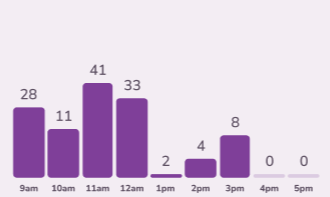
Each hourly bar includes any conversational turns that happened during that hour. Naptime can be confusing because children may be quiet for most of the hour, but the report may still show turns if interactions happened at the start or end of nap time.
Example:
-
Lunch ended around noon, and the class started naptime soon after.
-
Most children were asleep by 1:00. One child needed help settling, so a few turns appeared in the 1:00–2:00 hour.
-
A few children woke up near the end of nap time, which caused some turns in the 2:00–3:00 hour. Then more turns as everyone woke up.
Even though naptime was mostly quiet, the report correctly shows the few interactions that did happen.
Higher or lower turns than expected
Think of the LENA device like a human ear. Just as your hearing can be affected by what’s around you, the LENA device can be affected by the classroom environment. Background noise, distance, and how loudly someone speaks can all affect what LENA picks up.
LENA works best with near and clear talk between you and the children. It won’t catch every word or every conversation. And that’s normal!
Sometimes, devices are put on the wrong child, not turned on, or turned off early. If these things happen, they can affect your data.
If turns are lower than expected, ask yourself:
-
Is the child talking a lot, but not having back-and-forth conversations with adults?
-
Are adults further away or turned away from the child?
-
Is there a lot of background noise in the room?
-
Was the device on and placed correctly in the vest?
If turns are higher than expected, ask yourself:
-
How many children were present at that hour?
LENA hourly averages can be affected by how many children are present and how long each device is on. -
Is it the first or last hour of the day?
LENA reports an hourly average. If less than an hour of audio is captured, it estimates the hourly rate based on the available turns. This can make the reported turns slightly higher or lower than expected. -
Was that child spending time with another adult during the day?
*If you want extra support, ask a co‑teacher, center director, or coach to review your data with you.